
Get the S-FPS

Simplified Faces Pain Scale (S-FPS) image files
High-resolution images are available here:
EPS (1.42 MB) | TIFF (7.98 MB)
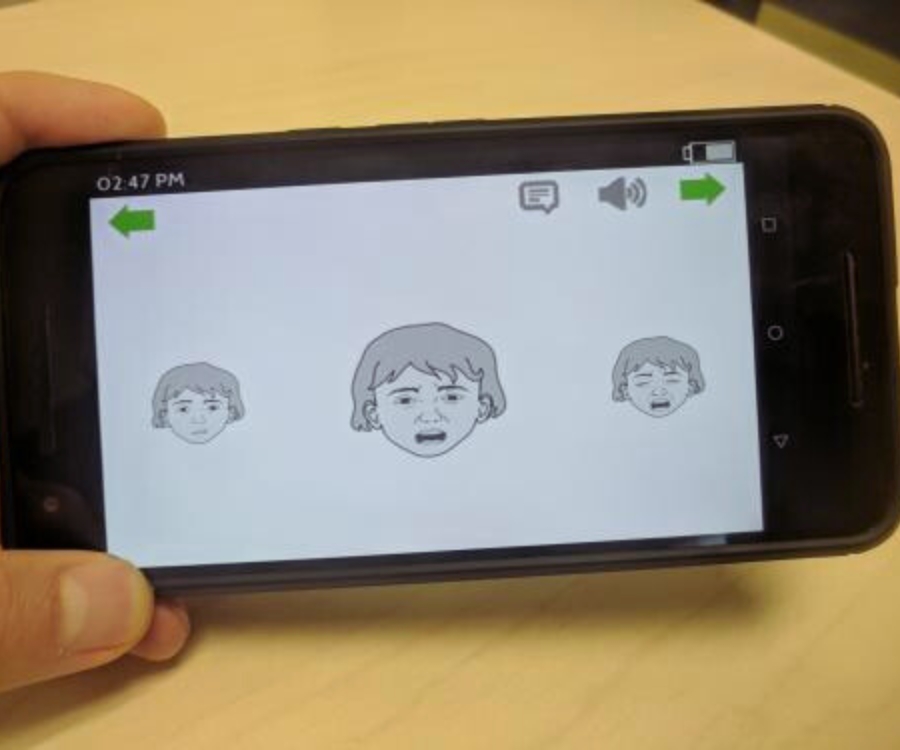
The monochrome/greyscale image may be printed, or used on an electronic device. For example, the S-FPS was implemented on a tablet device for its original evaluation (see Emmott et al.) and has been included in the Panda smartphone application for postoperative pain management in children (described in Sun et al., 2018).
The size of the full S-FPS image, displayed in landscape mode, should be 10 cm minimum width (preferably larger).

Permission for use and reproduction of the S-FPS
The Simplified Faces Pain Scale is licensed under a Creative Commons Attribution-NoDerivatives 4.0 International License. This allows the use and sharing of S-FPS (without further permission needed) in any medium or format, provided credit is given and this license is cited. No alterations may be published without permission. The minimum image caption is as follows:
Simplified Faces Pain Scale (S-FPS). Source: bcchr.ca/sfps
Licensed under CC BY-ND 4.0.

Citing the S-FPS
The primary S-FPS publication, which details the development and testing of the S-FPS is:
Emmott AS, West N, Zhou G, Dunsmuir D, Montgomery CJ, Lauder GR, von Baeyer CL. Validity of Simplified Versus Standard Self-Report Measures of Pain Intensity in Preschool-Aged Children Undergoing Venipuncture. J Pain. 2017;18(5):564-573. [Abstract]
If you also wish to include the S-FPS image, please cite this web page (bcchr.ca/sfps) and license details as above.

Instructions for use of the S-FPS
Ask whether he/she is in any pain, using terms that are age- and context-appropriate (e.g., “hurt,” “ouch,” etc.). The answer “no” can be scored as 0 on a 0-10 scale and the accompanying faces scale is not used. Only if the answer is “yes,” the child is presented with the S-FPS and asked to rate the intensity of their pain using the following language: “These faces show how much something can hurt. This face [point to left-most face] shows a little bit of hurt. This face [point to middle face] shows a medium amount of hurt. And this face [point to right-most face] shows very much hurt. Touch the face that shows how much you hurt right now.”
The three faces can be scored as three, seven, and 10 on a 0-10 scale.
Research with the S-FPS
We encourage use of the S-FPS in any research studies. Consider the following when designing your study and reporting your results:
– Report results separately by year of age (see von Baeyer et al., 2017).
– If multiple self-report scales are used, report the order in which they were administered.
– Report the number and type of difficulties encountered by children in using the scale.
– If the wording of instructions is adapted or altered, specify how.
Translate to other languages
This should be based on the method of translation, back-translation, and verification (see Publications):
Translate. Start with the English version given above, which has been evaluated in a clinical setting. Translate the instructions into the new language.
Read. Have the new version read by several people who are familiar with young children’s use of language (e.g., teachers, nurses). It should be suitable for children 3-5 years of age.
Back-translate. Have the new version back-translated into English by a bilingual person who does not know anything about the S-FPS and has not seen the original version. Compare the original with the back-translation and make any needed adjustments in the translation.
Pilot. Test the scale with several young children, noting any difficulties they have in understanding the instructions and again make any needed adjustments in the translation.
Disseminate. Decide how you will distribute the S-FPS image and the new version of the instructions to users and how they will be trained to administer the scale.
Once you have an established version, you may:
Collect data. It will be valuable to compare data using the S-FPS in different cultures and language groups. Gather data on pain scores from various groups, especially noting age, sex, and source of pain. As examples, Miró & Huguet (2004) and Newman et al. (2005) have done this with the Faces Pain Scale – Revised (FPS–R) in Spain and Thailand, respectively.