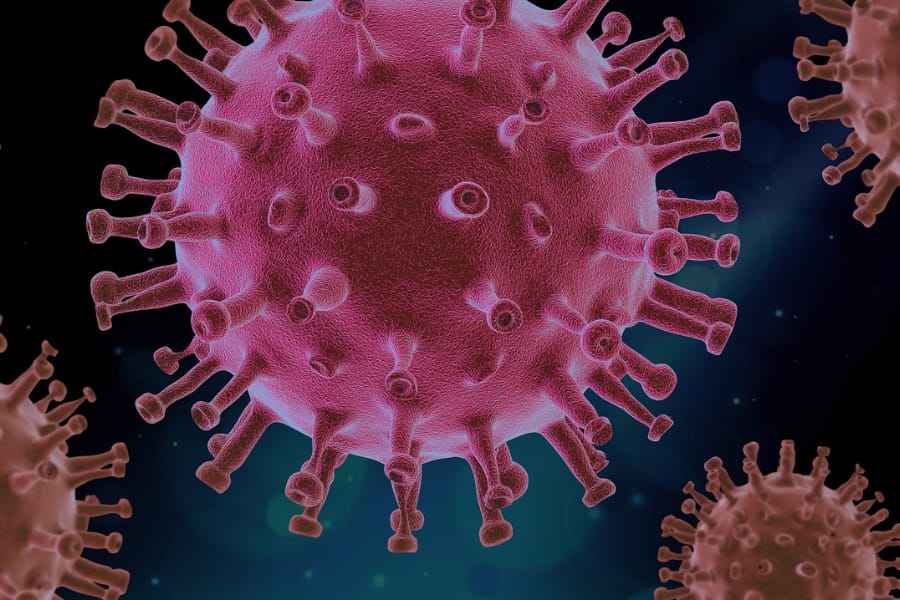
In the early days of the COVID-19 pandemic, many research teams around the world focused on creating antibody tests to diagnose individuals who had SARS-CoV-2, the virus that causes COVID-19. Surprisingly, some researchers detected low levels of antibodies in many individuals who had never been exposed to the virus.
It was not clear at the time whether these individuals could have contracted the virus without knowing, or if there was another reason for these results. To help solve this mystery, Dr. Pascal Lavoie and his team at BC Children’s compared the blood sera of adults who tested negative for COVID-19 with that of young infants who are much less likely to have been exposed to SARS-CoV-2 or other coronaviruses.
“We reasoned that babies’ sera, the part of blood that carries antibodies and other immune system components, can be used as a benchmark to detect antibody reactivity in adults who had never been exposed to SARS-CoV-2,” said Dr. Lavoie.
“Newborn babies have maternal antibodies passed down from the mother, but those gradually wane after birth. We collected blood samples from 45 babies who were younger than six months old, including 21 blood samples collected prior to the emergence of SARS-CoV-2 in B.C.”
The first set of samples collected from these babies all showed some antibody reactivity to circulating coronaviruses — likely due to remaining maternal antibodies. By the time the second set of samples was collected from the same babies eight months later, this reactivity had dropped dramatically.
Compared to these babies, the average adult has been exposed to other coronaviruses by the age of two. In fact, there are currently four circulating coronaviruses that pre-date SARS-CoV-2 and cause up to 30 per cent of seasonal upper respiratory tract infections.
The BC Children’s researchers compared the immune responses of the babies to those of 273 COVID-19-negative adults from Metro Vancouver, B.C., most of whom were health care workers and whose blood sera was collected between May and June, 2020. The antibody reactivity to SARS-CoV-2 in almost all of these adults was up to 100-fold higher compared to the infants at second blood sera collection.
Antibodies and cross-reactive immunity
“Those second infant samples allowed us to define new thresholds for SARS-CoV-2-antibody reactivity in adults who had not yet been exposed to SARS-CoV-2. Based on our results, we estimate that between 90-99 per cent of adults have positive antibody reactivity to SARS-CoV-2 antigens,” said Dr. Lavoie.
Further, since blood sera taken before the pandemic showed similar antibody reactivity as blood sera taken during the first wave, it can be concluded that this reactivity was not due to undiagnosed or asymptomatic COVID-19, but rather to already circulating, pre-SARS-CoV-2 coronaviruses.
Individuals can sometimes have pre-existing antibodies to a virus without having been exposed to it. This phenomenon, called cross-reactive immunity, occurs when someone is infected with another similar virus. However, these antibodies are usually immature, and because they were not developed by the body to specifically target SARS-CoV-2, they are not as effective at neutralizing the virus as an antibody one would develop from a vaccine or following an infection. Therefore, current SARS-CoV-2 vaccines remain the best way to reduce the risk of a severe COVID-19 infection for most individuals.
“While having pre-pandemic coronavirus antibodies seems like it would provide benefits, we’re not yet sure if this is the case,” said Dr. Lavoie.
“Cross-reactive antibodies generally bind weakly to a virus, but that does not mean that they can’t prime the immune system to respond to this virus. Some data suggest that having these antibodies may result in less severe COVID-19, while other data suggest the opposite.”
More research is required to understand how these pre-existing antibodies and immune responses affect the severity of COVID-19.
The research team is led by Dr. Lavoie and by postdoctoral fellow Dr. Abdelilah Majdoubi. The team includes:
- Fraser Health physicians Dr. Jean Gelinas and Dr. Disha Mehta;
- Dr. Matthias Görges, Dr. Vilte Barakauskas, Dr. David Goldfarb, Dr. Mike Irvine, Christina Michalski, Aaron Liu, Claire Cheung, and Lauren Muttucomaroe from BC Children’s;
- Colleagues from the Vaccine Research Center at the National Institutes of Health in the US;
- Dr. Steven Pelech, Dr. Dirk Winkler, and Dr. Sarah Dada from UBC; and
- Dr. Inna Sekirov and Dr. Agatha Jassem from BCCDC.
This research was funded by the BC Children’s Hospital Foundation, the Intramural Research Program of the Vaccine Research Centre (VRC) at the National Institute of Allergy and Infectious Diseases (NIAID), and the National Institutes of Health (NIH). The study was also funded in part by the Government of Canada via its COVID-19 Immunity Task Force.
Do you have a question about this article or other BCCHR news?
Contact BCCHR Research Communications.