
More than 2,500 cases of measles have been reported across Canada this year, including in BC, in the largest outbreak of the disease in decades.
With the Public Health Agency of Canada now warning we could lose our 30-year measles elimination status by the fall, many families are wondering what the sudden resurgence means for them.
“It’s one of the most contagious pathogens on the planet,” says Dr. Manish Sadarangani
We spoke with Dr. Manish Sadarangani, director and investigator of the Vaccine Evaluation Center at the BC Children’s Hospital Research Institute (BCCHR) and associate professor of pediatric infectious diseases at the UBC Faculty of Medicine, and Dr. Kyla Hildebrand, investigator at BCCHR and clinical associate professor and division head of Pediatric Immunology at the UBC Faculty of Medicine, about what makes measles so uniquely dangerous — and preventable.
1. Measles is up to six times more transmissible than COVID-19
Measles is mainly spread through respiratory particles, and can linger in the air for up to two hours after an infectious person has left a room. In an unvaccinated population, each person infected with measles spreads the virus to an average of 18 others — that’s around six times the rate for COVID-19.
“It’s one of the most contagious pathogens on the planet,” says Dr. Sadarangani.
– Dr. Manish Sadarangani


2. There is no cure for measles
“There isn’t a dedicated antiviral therapy available to treat measles. This fact is surprising to many who assume that all infections have a treatment,” says Dr. Hildebrand.
If an unvaccinated person has been exposed to measles, they may be given a dose of the MMR (measles, mumps and rubella) vaccine in the first three days after an exposure. But once illness occurs, says Dr. Sadarangani, “there’s nothing that’s specifically going to cure the infection or improve the outcomes of the infection. If you’re a child or infant, you’re more likely to develop severe infections and complications than if you have measles when you’re older.”
3. Measles can cause “immune amnesia”
Because the measles virus attacks your body’s own immune cells, including cells responsible for recognizing pathogens, it can erase up to 70 per cent of your previously acquired immunity.
“We have very clear proof from numerous very well-done studies that, after a measles infection, your immune system is suppressed for weeks to months,” says Dr. Sadarangani. “Some have suggested it may last up to two years.”
So even if you’ve recovered from measles, you’re at increased risk of contracting other illnesses — including those you’ve fought off or been vaccinated against, such as COVID-19 or the flu.
There isn’t a dedicated antiviral therapy available to treat measles. This fact is surprising to many who assume that all infections have a treatment.
– Dr. Kyla Hildebrand

4. Measles can cause serious brain damage — even decades after an initial infection
In about one in 1,000 cases, measles causes brain inflammation, called measles encephalitis, which can lead to serious brain damage, deafness or even death.
More rare is a progressive and fatal brain condition called subacute sclerosing panencephalitis (SSPE), which typically surfaces around 10 years after a person is infected. It can occur in up to one in 5,000 unvaccinated people infected with measles — but this number goes up to about one in 620 for infants under 15 months. “It’s just very sad because it’s invariably fatal and there is no treatment or cure,” says Dr. Sadarangani. “The tragedy is that it is completely avoidable.”
5. At least 95 per cent of the population must be vaccinated against measles for herd immunity
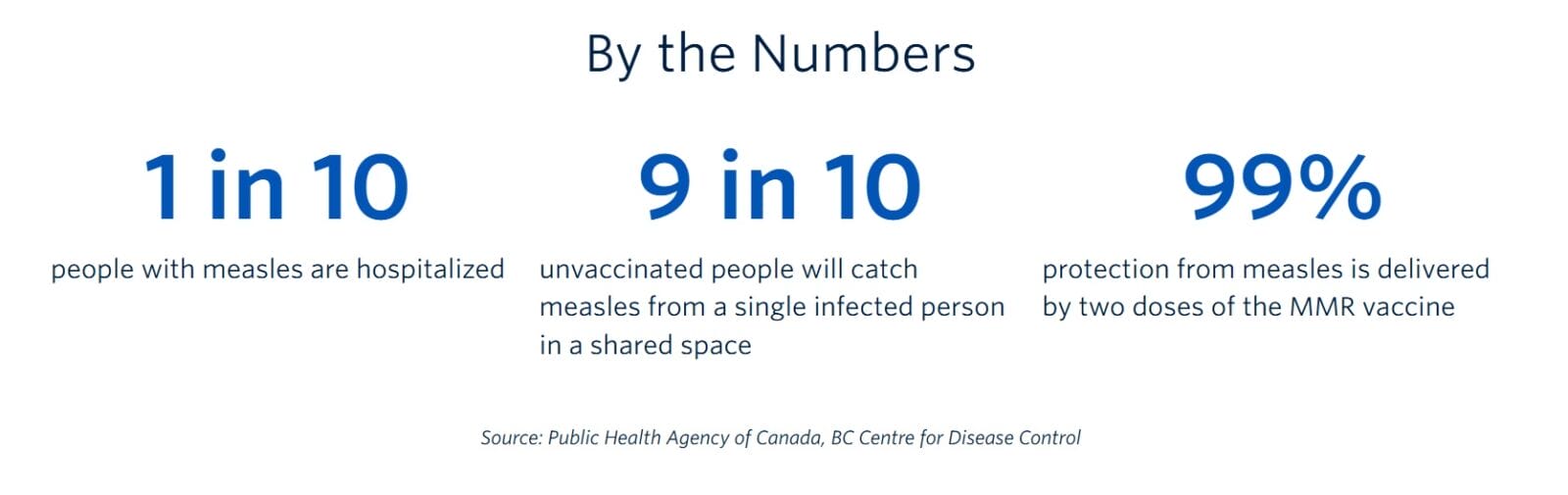
When vaccination rates reach 95 per cent or higher, measles can be kept at bay through herd immunity. One dose of the MMR vaccine given at 12 months is 85 to 95 per cent effective at preventing measles. A second dose, typically given between 18 months and six years of age, brings protection up to 99 per cent.
Currently, B.C. vaccination levels are at their lowest in 20 years, with only 72 per cent of seven-year-olds in B.C. fully vaccinated against measles in 2023. In some areas of the province, rates have fallen below 65 per cent. That leaves those who can’t get the vaccine, including infants and pregnant or immunocompromised people, at risk.
“The MMR is an extremely effective vaccine, and for almost everyone will give lifelong protection,” says Dr. Sadarangani. “Being fully vaccinated is the best way to protect yourself, your family and vulnerable members of our community.”
Credit: UBC Faculty of Medicine