
Dr. Genelle Lunken started running at age three. She leapt into track and field, kickball, as well as rugby — even though it was considered a “boy’s sport” in her native New Zealand — tennis, volleyball, cricket, golf — even lawn bowling. She also rolled into gymnastics, “But I was terrible at that. I was too tall and lanky to be a gymnast.”
This tall, lanky jock ate dinner-sized snacks before supper and dove into her mom’s zesty lasagna and spaghetti Bolognese. Her mom was a great cook and food felt important.
“Kiwis love fish and chips so that would be our treat. I grew up in a very small town. We didn’t have McDonalds or anything like that. We just got Subway a few years ago, so we had Chinese food and fish and chips.”
When she was in her early teens, her mom bought her a book on the interplay between sports performance and nutrition that fuelled a keen interest in health and diet. “It was written by a very well-known sports dietitian in New Zealand, Jeni Pearce, who I eventually ended up meeting — which was awesome.”
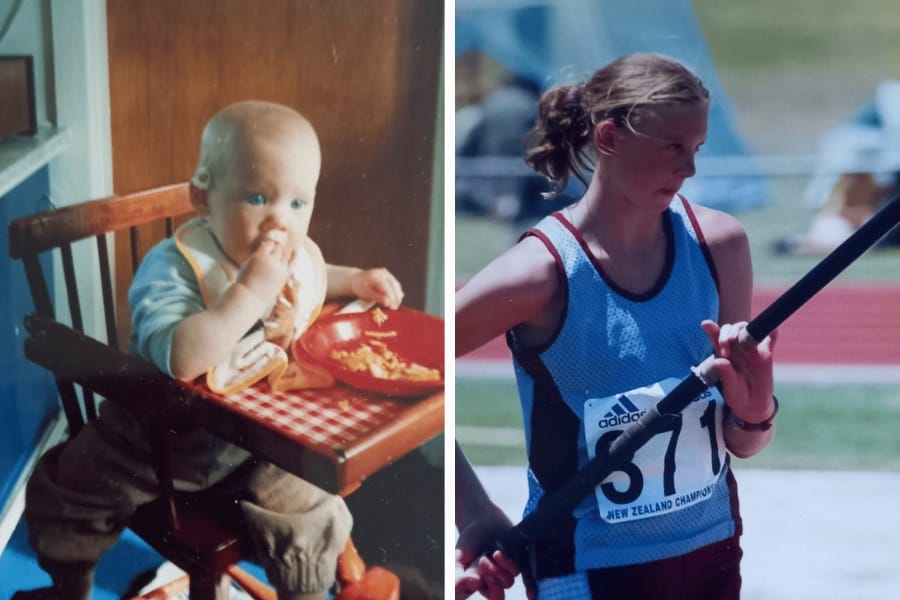
Genelle Lunken as a baby and about to compete in pole vault as a teenage athlete.
Dr. Lunken’s passion for nutrition led her all the way to the completion of a PhD in Nutritional Science.
Today, studying how diet affects gut health is Dr. Lunken’s jam — along with running, skiing, cooking and sampling new-to-her cuisines.
She originally joined BC Children’s Hospital Research Institute as a postdoctoral fellow working with Dr. Bruce Vallance and Dr. Kevan Jacobson. Now, she’s a grant-tenure track assistant professor with the Faculty of Medicine at the University of British Columbia and establishing her own lab at the Research Institute. She is also a dietitian and translational research lead at the IBD Centre of BC.
Mind the gaps
Five years into her career as a dietitian, Dr. Lunken longed to increase awareness of the importance of nutrition among other health professionals.
“I was getting a little frustrated,” she says.
At times, she bumped up against medical teams that didn’t understand the importance of nutrition as part of treatment for conditions such as inflammatory bowel disease (IBD), and she could understand their reluctance.
“The evidence around at that time was pretty weak. There weren’t a lot of studies to support nutritional therapy,” she says.
Dr. Lunken’s PhD research examined how dietary fibre intake impacts the effectiveness of taking a fibre supplement to shift the microbiome, the collection of microbes, including bacteria, fungi and viruses that naturally live in and on our bodies.
She moved to Vancouver for postdoctoral work at BC Children’s in 2017, keen to focus on gastrointestinal disease and to improve her basic science techniques.
We know nutrition interventions have a significant impact on the development and management of inflammatory bowel disease, but we’re really just at the tip of the iceberg.
– Dr. Genelle Lunken


“I wanted to become an expert in this area and help move the field of nutrition and dietetics forward to help support dietitians and medical teams make decisions around patients’ nutrition to benefit their health outcomes. We know nutrition interventions have a significant impact on the development and management of inflammatory bowel disease, but we’re really just at the tip of the iceberg.””
As a postdoctoral fellow working with Dr. Bruce Vallance and Dr. Kevan Jacobson as well as on the Gut4Health team, Dr. Lunken (formerly Healey) found that enriching the liquid diet that’s the gold standard of treatment for Crohn’s disease with a specific type of fibre supported the growth of beneficial bacteria in the gut and increased anti-inflammatory immune cells in the body.
From postdoctoral fellow to principal investigator
Dr. Lunken is now applying for grants to study this enriched fibre treatment in pediatric patients at BC Children’s with Crohn’s disease and ulcerative colitis, the two main forms of IBD. She’s also seeing adult patients once a week at the IBD Centre of BC and working with gastroenterologists who share her interest in precision medicine and nutrition to build the centre’s translational research program.
“This was a really good way of me being able to keep clinically relevant and in touch with my patients — because I learn so much from them — while also being able to research this area,” she says.
Dr. Lunken is also collaborating on a digital health application that would enable people with IBD to accurately assess their dietary intake in real time and has applied for funding to validate the app.
While bacteria are the main component of the gut microbiome, Dr. Lunken is keen to study the impact nutrition has on fungi and viruses in our guts.
“There are studies coming out that show fungi and viruses are probably implicated in IBD,” she says. “We have yet to see if that’s going to make any major impacts over bacteria, but I think it’s worth looking at because it’s a really untapped area of research right now.”
Ultimately, Dr. Lunken hopes her lab will help move nutrition, microbiome and IBD research forward towards personalized therapy.
My motivating factor is my patients. There are so many research questions that come to mind when I’m speaking to them. It’s really exciting to have the possibility of actually developing a study around those real-life experiences that patients are living.
– Dr. Genelle Lunken
“That may not happen in my lifetime, but I hope to at least generate some results that will eventually lead to that being able to happen,” she says. “My motivating factor is my patients. There are so many research questions that come to mind when I’m speaking to them. It’s really exciting to have the possibility of actually developing a study around those real-life experiences that patients are living. That’s really what I’m trying to achieve in the lab.”