
Dr. Matthew Wiens and colleagues at the Institute for Global Health at BC Children’s & Women’s Hospital, BC Children’s Research Institute, and the University of British Columbia, are the first Canadian Team to lead a Horizon Europe Pillar 2 project. The consortium was recently awarded €5 million under the Global Health EDCTP3 Joint Undertaking for a project that aims to reduce childhood deaths from severe infection (sepsis) after hospital discharge.
Horizon Europe is the world’s largest research and innovation program and the Global Health EDCTP3 Program focuses on accelerating clinical development of health innovations.
The successful project, REConeCteD: Risk Enhanced Community Care after Discharge, builds on the group’s Smart Discharges program, which leverages digital health technologies to identify children at highest risk after hospital discharge and target personalized follow-up care using data-driven prediction models.

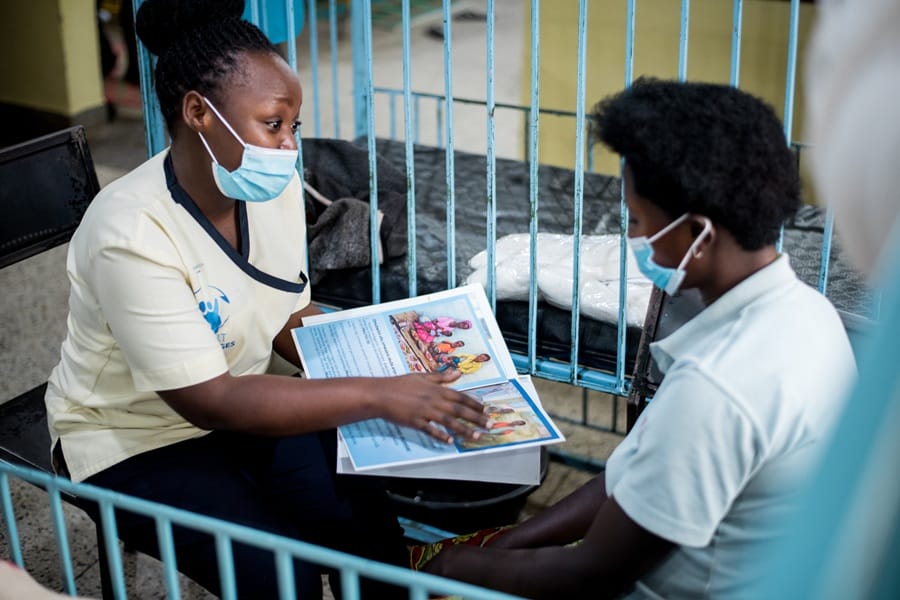
Using the Smart Discharges digital program, health workers can determine a child’s risk after discharge.
Follow-up care is crucial for children in the weeks and months following discharge from hospital after suspected or proven sepsis. Eleven million people die of sepsis every year, with the vast majority of deaths occurring in low- and middle-income countries. Importantly, studies have shown that more than one in 20 children younger than five years of age who are admitted with suspected sepsis die within six months after being released from hospital.
“In East African countries such as Uganda, there have been concerted efforts to build up referral systems to better connect community care to facility-based care, however the reverse isn’t true,” says project lead Dr. Matthew Wiens. “Once a child is discharged from hospital, there aren’t enough resources or strategies in place to inform home communities of the need for follow-up care.”
Dr. Matthew Wiens is the lead BCCHR investigator for the REConneCteD project.

The goal behind the Smart Discharges and REConneCteD projects are to identify and prioritize the children at highest risk, emphasize the importance of practicing healthy behaviors at home, how to seek care when needed, and staying connected to the health care system. One of the ways this has been made easier is through the introduction of the electronic Community Health Information System (eCHIS) — a mobile application by the Ministries of Health in several African countries to digitize community health services. By digitally linking e-CHIS with a child’s electronic health record, REConneCteD will help ensure that the most at-risk children are reconnected with community health workers for follow-up after discharge. It can also provide information and education through the platform to community health workers about disease prevention, diagnosis, and treatment of childhood diseases.
It can take months for a child hospitalized for sepsis to fully recover and this period is fraught with the risk of re-infection, further health complications, or even death.
– Dr. Matthew Wiens

“It can take months for a child hospitalized for sepsis to fully recover and this period is fraught with the risk of re-infection, further health complications, or even death” says Dr. Wiens. “With REConneCteD, these children can be connected to community health workers to make follow-up care easier.”
The Smart Discharges platform was originally conceived in 2011 to address the gap in care following hospital discharge and to find better ways to use limited resources intelligently and precisely to help as many people as possible. The program focuses on the patient to ensure that the intensity of post-discharge care is linked to individual risk. The Smart Discharges risk models, which have been derived and validated in several studies over the past 10 years, use a handful of basic clinical and social factors to accurately predict the risk of post-discharge mortality.
Developing this tool was made possible by many funders and contributors, including BC Children’s Hospital Foundation and Mining4Life. This support was given in the recognition that many lives could be saved if hospitals had the tools to ensure these patients could survive and thrive after going home. A study that enrolled more than 13,000 children in Uganda, currently published as a preprint, found that the Smart Discharges platform significantly reduced post-discharge mortality.
By creating locally adapted guidelines as well as training materials and educational resources for caregivers, such as videos on how to recognize danger signs, we can go a long way towards ensuring better health for these children.
– Dr. Matthew Wiens
“The secondary benefit of this digital platform is its use for education,” says Wiens. “By creating locally adapted guidelines as well as training materials and educational resources for caregivers, such as videos on how to recognize danger signs, we can go a long way towards ensuring better health for these children.”
Working with collaborators including the KEMRI-Wellcome Trust Research Programme (Kenya), Walimu (Uganda), and Brock University, the team will evaluate the impact on post-discharge mortality in a robust clinical trial.
“Following the trial, we anticipate that REConneCted will be in a position where national scaling within digitized regions is a real possibility. Even in areas with limited digitization, we are building processes and systems that can support improvements in the facility-to-community transition of care for children.”
With the establishment of the Institute for Global Health, BC Children’s Hospital and researchers in Vancouver have built up a reputation as one of the leading institutions worldwide on improving sepsis care.
On July 3, 2024, the Government of Canada and the European Union signed an agreement allowing Canada’s enhanced participation in Horizon Europe under Pillar 2. Canadians can now access a broader range of research opportunities, and applications from Canadian researchers and innovators will be reviewed as members of consortia in Pillar 2 calls. Pillar 2 aims to solve some of the world’s biggest problems.
UBC researchers interested in being part of a consortium applying for Horizon Europe Pillar 2 funding should visit https://sparc.ubc.ca/horizon-europe.
This work is funded by the European Union under Global Health EDCTP3. Views and opinions expressed are, however, those of the author(s) only and do not necessarily reflect those of Global Health EDCTP3 nor its members. Neither of the parties can be held responsible for them.