
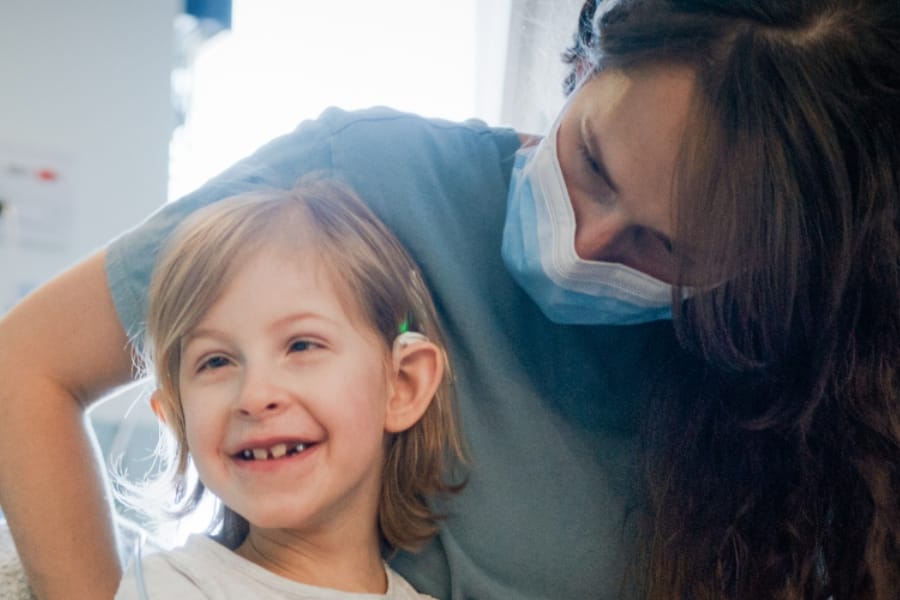
All her life, Rebecca Traun has been the subject of countless medical investigation. With a cleft palate, extremely low red blood cell counts, hearing impairment, and constant fatigue, the little girl has spent a lot of time at BC Children’s Hospital.
“Every day, doctors had another suggestion for a different disease or syndrome,” says Sarah Traun, Rebecca’s mother. “I would be told ‘maybe it’s this disease’ or ‘maybe it’s that disease.’ Then I would go online and Google yet another disease. And there was a lot of ‘we’ve never seen this before.’ It was horrible not knowing why Rebecca was so sick.”

Rebecca has endured countless invasive tests and appointments to find out what is causing all her symptoms.
For several years, it has been a diagnostic odyssey of invasive tests and exhausting appointments for Rebecca. But despite the pokes and prods, and feeling ill, the now six year old continues to wake up smiling every day.
“Rebecca is strong,” Sarah says. “She’s always happy, no matter how sick she is or how many times she has to be poked or prodded.”
Not as rare as you think
A rare disease is a condition affecting fewer than one person in 2,000. There are more than 7,000 known rare diseases and dozens more being discovered each year, so the irony is rare diseases are actually quite common.
In B.C., one in every 25 children born is affected by a rare disease, and many of these kids, like Rebecca, require intense medical follow-up and care. Children with rare diseases occupy one in every three beds at BC Children’s Hospital and often endure a journey filled with dozens, sometimes hundreds, of tests, and multiple visits to several different specialists. Some of the children and their families eventually get answers as to what is causing their symptoms, but almost half the cases remain medical mysteries.
We provide the best care possible to each and every child, but without a diagnosis, sometimes it’s just not enough. We must do better than that.
– Dr. Stuart Turvey

“BC Children’s is often the final frontier for these kids and families who come to us from all around the province,” explains Dr. Stuart Turvey, a pediatric immunologist and the lead of the Precision Health Initiative. “We provide the best care possible to each and every child, but without a diagnosis, sometimes it’s just not enough. We must do better than that.”

Rebecca and her family finally started getting answers once Dr. Stuart Turvey and the Precision Health Initiative team got involved in her care.
New funding will provide answers to more children and families
That’s where the Precision Health Initiative (PHI) comes in. Funded by Mining for Miracles, the BC mining industry’s long-standing fundraising campaign for BC Children’s Hospital Foundation, the PHI aims to provide answers to an additional 25 per cent of rare disease patients and their families. The ambitious goal is for three out of every four children with rare diseases in B.C. to have a diagnosis. Emerging technologies have shown great promise in finding answers for patients who remain undiagnosed using the current clinical tools available to clinicians.
Through the PHI, clinicians will be better able to combine the rigour of the scientific process and the knowledge of leading research experts to help solve these mystery cases and provide guidance for the care of these kids.
– Dr. Anna Lehman

“Through the PHI, clinicians will be better able to combine the rigour of the scientific process and the knowledge of leading research experts, locally and internationally, to help solve these mystery cases and provide guidance for the care of these kids,” emphasizes Dr. Anna Lehman, co-lead of the Rare Disease Discovery Hub at BC Children’s.
Precision health involves studying each child’s unique set of characteristics, gaining deep insight into their specific genetic, molecular, cellular, and environmental traits, rather than the typical one-size-fits-all approach. This enables researchers and clinicians to tailor treatment specific to the patient, combining world-leading expertise with the most advanced precision health tools available.

The children who are part of the PHI will have access to diagnostic tools not available in regular clinical care.
Getting precise with powerful new diagnostic tools
Children and families who have exhausted current clinical care avenues can be enrolled into the PHI research project via their clinical champion, usually their specialist at BC Children’s. The champion will interface with the family and care team to navigate the process, and work alongside the PHI team to determine which precision health technologies may provide insight for the child’s condition. These technologies, normally not available through routine medical care, enable the study of each patient at the cellular and molecular level, and are collectively referred to as multi-omics.
Emerging technologies which enable in-depth biological profiles of patients are transforming our understanding of health and disease, providing clinicians and researchers with the tools to diagnose and treat both rare and complex diseases in a precise manner tailored to each patient.
– Dr. Phil Richmond

“Emerging technologies which enable in-depth biological profiles of patients are transforming our understanding of health and disease, providing clinicians and researchers with the tools to diagnose and treat both rare and complex diseases in a precise manner tailored to each patient,” says Dr. Phil Richmond, staff scientist at the PHI. “It’s now possible to examine the core components of molecular and cellular physiology, including the genome, proteome, metabolome, microbiome, and epigenome (“multi-omic” data) of patients in a comprehensive manner.”
Training the next generation of precision health experts
The PHI will also solidify BC Children’s as an international leader in precision health. With a focus on training and knowledge translation, the program will help establish the next generation of precision health experts. New researchers will learn from today’s leaders, creating an ongoing cycle of knowledge translation and innovation.
Clinicians will be able to access training on the fundamentals of genomic diagnostics, as well as resources to interpret results from emerging advanced diagnostic tools. As genome diagnostics become key tools used in the clinical domain, the PHI seeks to equip doctors with the knowledge and know-how to use these tools to their full potential. On the research side, training will focus on big data analysis, bioinformatics, and how to effectively utilize these new technologies to understand health and disease.
Precision health research will change the future
Ultimately, the PHI will ensure kids like Rebecca will be able to plan for their future. Last year, Dr. Lehman, Dr. Turvey and their teams started investigating Rebecca’s rare disease. They conducted advanced genomic sequencing and discovered she has a previously undiscovered genetic variant that is responsible for all of Rebecca’s symptoms. They found that Rebecca had a change in a gene critical for controlling the function of her immune system, and for the development of her facial structures and inner ears.
We finally had an answer. For the first time, I actually felt closure.
– Sarah Traun

“I thought, ‘This is it, they found it.’ It was the first time that things started making sense,” Sarah says. “We finally had an answer. For the first time, I actually felt closure.”
The next step is for researchers to find a way to treat Rebecca’s genetic variant. For now, the diagnosis has enabled her medical team to refine their approach to Rebecca’s care. It also confirmed that the intravenous immunoglobulin treatments she has been receiving are helpful for her symptoms. Equally as important, she and her family now have hope.

Dr. Stuart Turvey and the PHI team helped uncover the genetic variant causing Rebecca’s symptoms.
Such breakthroughs keep clinicians and researchers motivated to continue pushing the boundaries.
“New technologies allow for answers that couldn’t be found 10 years ago. For example, re-analysis of a patient’s DNA can find newly published disease-causing changes that were not looked for previously. New discoveries can happen faster and faster, and we are now able to harness a wide range of new tools,” says Dr. Turvey. “It’s a great feeling to provide answers for families who have been searching for years, sometimes decades.”
BC Children’s researchers and labs: Find out how you can get involved in the PHI by visiting the webpage on ResearchHub (intranet).