Dr. Julie Robillard is a Scientist in Patient Experience at BC Children’s Hospital and Women’s Hospital + Health Centre, and an assistant professor of Neurology at the University of British Columbia.
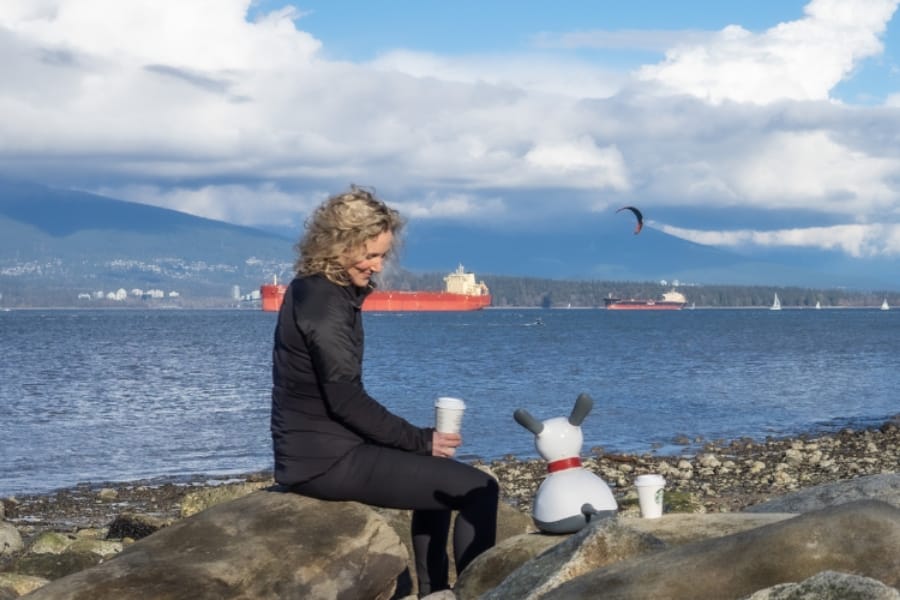
Her lab, the Neuroscience, Engagement and Smart Tech (NEST) group at BC Children’s, conducts research on current and emerging technologies that support brain health. The NEST team works to better understand how social technologies like robots or social media can support the mental health of children, adolescents and families. Dr. Robillard’s group also investigates patient experience at BC Children’s more broadly, with a focus on finding how it can be improved.
Dr. Robillard will be the moderator at this year’s Women in Science event on Feb. 9, 2023.
Early life and inspiration
I was lucky to grow up in a household that nurtured my curiosity for the natural world and encouraged me to seek a career that would challenge me and allow me to pursue my interests. My PhD training was in the biological basis of learning and memory, and a big role model for me was Dr. Brenda Milner – a Canadian neuropsychologist who, in the 1950’s, was invited to study H.M., the most famous patient in cognitive neuroscience. Her work with H.M. and others led to landmark discoveries in how memories are stored and processed in the brain and her major contributions shaped our understanding of brain function and organization. She is now 104 and still conducting research at McGill University. I find that lifelong quest for knowledge to be incredibly inspiring. I had the pleasure of meeting her in 2014 and it was a defining moment for me.
While Dr. Milner was one particular example, one of the amazing things about being part of the community here at the Research Institute is that I am surrounded by role models.
Every day I learn and grow by interacting with enthusiastic trainees at all levels, as well as dedicated and creative research staff, engaged patients, families and health-care providers, and impact-driven faculty.
The brain as the final frontier
My schooling background was all in Québec — right up until the end of my bachelor’s degree — where there is a mandatory two-year program called the College of General and Professional Teaching (CÉGEP), between high school and university. For me, this program was incredibly helpful, because it gave me the opportunity to meet faculty with research experience before I had to make a decision about my undergraduate program.
I had terrific instructors in math and biology, and fell in love with the scientific method. What I found most interesting was how much you could learn from an experiment that failed!
This led to my choice of biological sciences for my undergraduate degree.
Early on during my bachelor’s, I became fascinated by the brain. It seemed to me like the last frontier, the one piece of the human code we just couldn’t crack. I ended up learning how to conduct electrophysiology experiments in Dr. Trudeau’s lab at Université de Montréal and my newfound love of neuroscience really grew into my career path. There was something so incredibly exciting about watching electrical signals from brain cells communicating with each other and being able to contribute to our understanding of how that happens.
From there, I went on to do a PhD in neuroscience with Dr. Brian MacVicar at UBC. There, I experimented with cutting-edge techniques to further my expertise. During these PhD years, I became interested in the gap between the work I was doing in the lab and how the knowledge I was generating was used in the real world. This led me to explore research fields at the intersection of neuroscience and society. As my interests evolved to include translational work, I went on to study neuroethics under the supervision of Dr. Judy Illes at Neuroethics Canada, who happens to be a tireless advocate for women in science and engineering.
Advice for others
My advice for others would be to take every opportunity to network with people from a wide range of backgrounds. You never know when you’ll cross paths with someone who will become a major influence in your journey, or who might inspire you to take a particular direction you hadn’t expected.
Registration is open to high school students, university students, the health science community and the general public. The curriculum and discussion will be targeted for a grade 10–12 education level. The event will be hybrid with the option of attending in-person or virtually.
Main Photo Credit: Paul Killeen