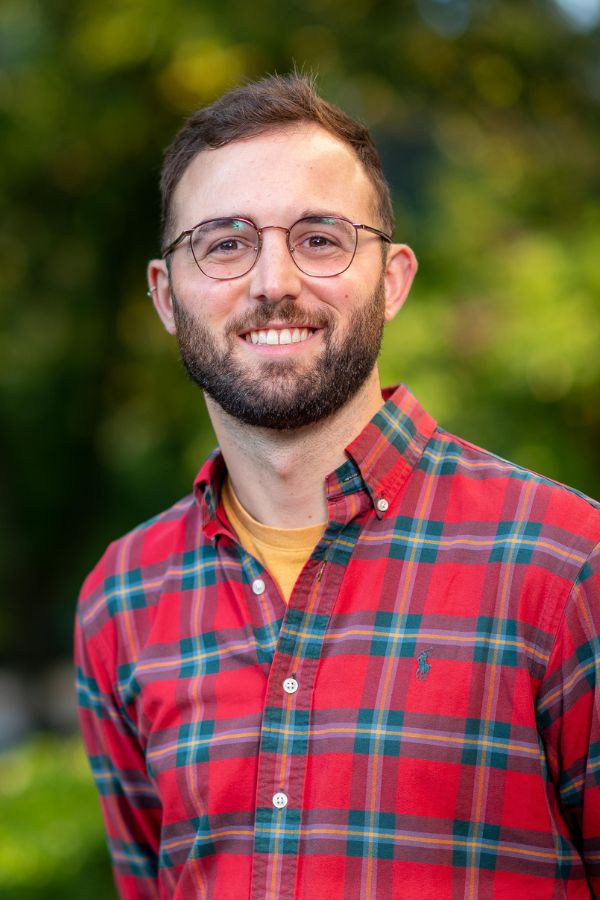
Mental health and substance use challenges are some of the most pressing issues impacting young people. These topics are the focus of Dr. Trevor Goodyear’s research program at BC Children’s Hospital Research Institute (BCCHR). Dr. Goodyear joined BCCHR as an investigator in October 2025. “One of the reasons I'm drawn to working with youth is the fact that mental health and substance use challenges often first arise in this early developmental period — up to around age 25,” he says.
Dr. Goodyear’s interest stems from several years working as a registered nurse in Ontario and British Columbia, including in child and adolescent mental health at BC Children’s Hospital (BCCH). “Great work has been done to support young people who use drugs and experience mental health challenges, but there are still gaps in systems and approaches to care,” he says. The drive to improve care for youth and other vulnerable groups inspired him to pursue a PhD in nursing at the University of British Columbia (UBC). He wanted to gain more knowledge to address those gaps and improve health outcomes.
Since completing that PhD in 2024, Dr. Goodyear has been working as an assistant professor in UBC’s School of Nursing and is affiliated with the Human Early Learning Partnership in the School of Population and Public Health. We sat down with him to learn about his health-care journey and plans to advance research on mental health and substance use.
How has your work as a registered nurse driven your research?
As a young person, I saw many people close to me experience mental health and substance use challenges. Those events gained new meaning when I began my nursing work with people who used drugs, experienced specific mental health challenges, or both, helping them set and accomplish their goals. We may think of these challenges as health problems, but I think they are also fundamentally social issues.
When I worked as a nurse, my clinical role was mostly in inpatient hospital settings. My research has taken me in a direction where I’ve been focused on community experiences of mental health and substance use challenges. A lot of my recent work has been through a public health lens and looking at enhancing primary care services and social services for young people grappling with these issues.

How do mental health and substance use challenges intertwine?
When moving between adolescence and adulthood, young people go through transitions impacting several aspects of their lives, including school and their relationships with themselves and others. They’re also dealing with broader societal stressors, such as the climate crisis, racial inequity, and regression of LGBTQ rights. Additionally, even though many young people have tremendous resilience, we’re living in challenging times.
Substance use and mental health challenges can sometimes have a bidirectional relationship, meaning they are interrelated and can influence each other. The young people I’ve worked with describe wide-ranging motives around substance use. Sometimes, it’s to feel better, to cope, or to “get by.” It can also be a means to help with attention and productivity, and a source of pleasure, connection, and experimentation — which to them are important gains. These complexities aren’t always captured by the health-care system because we often focus on risks and harms associated with substance use, which are of course very real too.
Considering your public health training, what are some public health-related priorities?
I’ve seen growing acknowledgement of the mental health and substance use challenges affecting children, teens, and young adults. But much of the investment still goes toward reactive services — acute care and emergency departments that are essential, but only once harms have already occurred. I’d like to see more focus on prevention and mental health promotion, and on addressing the social and structural determinants of health. If everyone had access to a nurturing early childhood environment, strong cultural and community supports, recreation, quality housing, and childcare, we’d see a profound positive shift in mental health and substance use trajectories across the lifespan.

What are your research highlights this year?
We recently published the findings of a study where the team interviewed 116 young people navigating a complex set of issues, including psychosis, antipsychotic treatment, and stimulant use. Psychosis is a condition characterized by symptoms such as disorganized thoughts and behaviour, hallucinations, and delusions, which lead to a distorted sense of reality. Causes of psychosis include a mix of biological and environmental factors.
This study stems from my colleague Dr. Danya Fast’s research program, in which I was involved as a PhD student. The study highlights that, when working with youth who use drugs or experience mental health challenges, we should prioritize their self-determination regarding treatment plans as much as is safe to do so. Mental health and substance use treatment and other systems of care are designed to help. However, they can inadvertently signal danger to young people experiencing overlapping inequities and using drugs intensively because they have often had complex histories with systems of care — personally and intergenerationally.
Another important finding is the need for supports to address individuals’ immediate priorities, which could be different from the health issues that brought them to a hospital. Maybe they don’t have a place to live, meals to eat, or connection with loved ones they can rely on, so we should address their concerns holistically.
When it comes to psychosis and antipsychotic treatment involving young people who use drugs, an emphasis on care is often associated with the need to stop or severely limit substance use, which wasn’t always a realistic goal for the youth we interviewed. Our study shows we need to figure out together what’s doable to keep youth engaged in care. We want to keep trusting relationships with them so we can provide more robust help whenever they’re ready, which can have an optimal impact on their health.
Why does equity in research matter?
Equity is a priority so we can direct our research to addressing avoidable differences in health across groups facing social and structural injustices. We can prioritize equity in the research process as well by using more community-engaged approaches, paying people with lived experience for the time and expertise contributed to research, giving credit where it’s due, being reciprocal in our relationships, and ensuring mutual benefits.

What’s coming next?
As part of building my research program, I’ve been developing collaborations with BCCHR staff and investigators, youth and community services, and non-profits across Canada while strengthening my existing partnerships. I’ve also been applying for grants and recruiting trainees interested in youth mental health and substance use to build capacity among up-and-coming researchers.
In one of my projects, I’m looking at youth overdose prevention by asking young people about social and structural factors that might protect them against overdose risks. Our research involves participatory photography, so participants will be expressing their perspectives by capturing and describing community images that are relevant to them.
I’m also involved with BCCH’s Missing Middle program, focused on transition-aged youth with moderate mental health and substance use challenges. Some of these young people may be considered too unwell for community-based mental health care alone but not unwell enough for acute services, so they may not receive adequate care. I’m working with Dr. Allie Slemon and Dr. Emily Jenkins to better understand and address the Missing Middle issue.
I’m happy to bring my nursing perspective to BCCHR and learn from interdisciplinary teams and community partners so we can continue to improve support for pediatric patients.